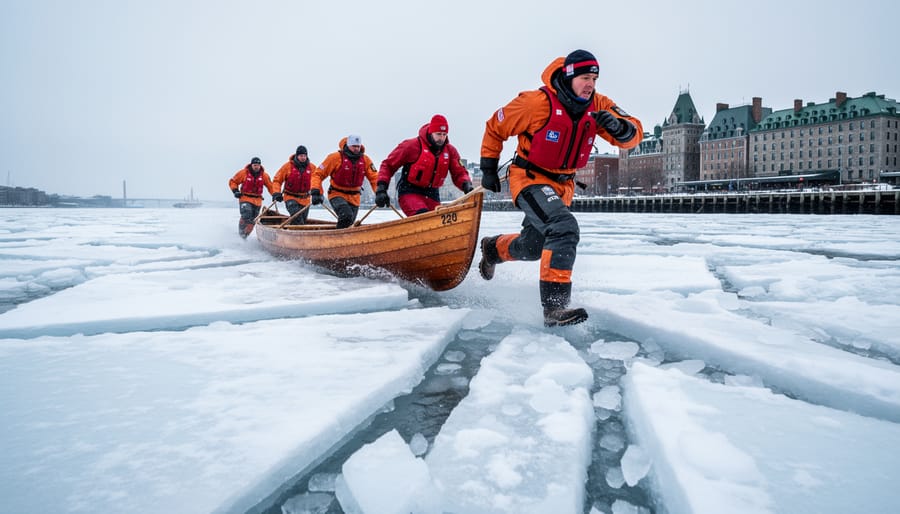
Ice canoe racing in Quebec is exactly what it sounds like: teams of five paddlers navigating massive canoes through a treacherous mix of frozen St. Lawrence River ice chunks and frigid open water, battling brutal wind and crushing physical demands over a roughly six-kilometer course. The sport traces its roots to 19th-century river workers who ferried passengers and goods across the frozen St. Lawrence before bridges existed, and today it’s evolved into one of the most extreme spectator sports you can catch during a Quebec winter.
The Montreal Ice Canoe Challenge stands as the province’s premier event, drawing elite teams from across Canada and beyond to compete right in Old Montreal’s historic port. Picture this: athletes sprinting across ice floes while dragging 200-pound canoes, then leaping in to paddle through bone-chilling water, only to scramble out seconds later to haul their boats over the next sheet of ice. It’s part Arctic expedition, part CrossFit competition, all adrenaline.
If you’ve been hunting for something legitimately unique to do during Montreal’s winter months beyond the usual skating rinks and ski hills, watching these teams battle the elements delivers serious bragging rights. The best part? It’s free to watch from the Old Port boardwalk, though you’ll want to bundle up with hand warmers and maybe spike your hot chocolate because temperatures regularly hover around minus-fifteen. Teams compete throughout January and February, transforming the waterfront into an unexpected winter sports hub that perfectly captures Quebec’s embrace-the-cold mentality.
What Makes Ice Canoe Racing Quebec’s Most Intense Winter Sport
Picture this: five athletes clad in survival suits launch a 180-pound canoe into a churning mix of ice chunks and freezing water, sprinting across slabs that could shift beneath their feet at any moment. That’s ice canoe racing on the St. Lawrence River, a centuries-old Quebec tradition that transforms winter survival skills into one of the province’s most visually stunning and physically punishing sports.
Unlike traditional paddling, ice canoe teams constantly switch between three modes of movement. When they hit open water, they paddle hard through waves thick with ice fragments. When they reach solid ice floes, everyone jumps out and hauls the canoe across the frozen surface at a dead run. The real challenge hits in the slush zones, unstable ice that can’t support weight, where racers push the canoe while half-swimming, half-clawing through the frigid mixture. It’s exhausting to watch, let alone experience.
The physical toll separates ice canoe racing from gentler winter pastimes. Teams need explosive strength to heave their canoe onto ice shelves, cardiovascular endurance to maintain race pace in survival suits, and split-second coordination to avoid flipping in rough water or losing teammates to ice breaks. One wrong step means a plunge into near-freezing water; hesitation costs crucial seconds as competing teams surge ahead.
What makes this a spectator magnet is the raw, visible struggle. You can see racers’ breath freezing in the air, hear the crunch of ice under boots, and watch teams gamble on risky shortcuts across questionable ice. The St. Lawrence becomes an arena where nature sets brutal terms and athletes meet them head-on, pure adrenaline wrapped in Quebec winter grit.
The Montreal Ice Canoe Challenge: Course and Competition Format
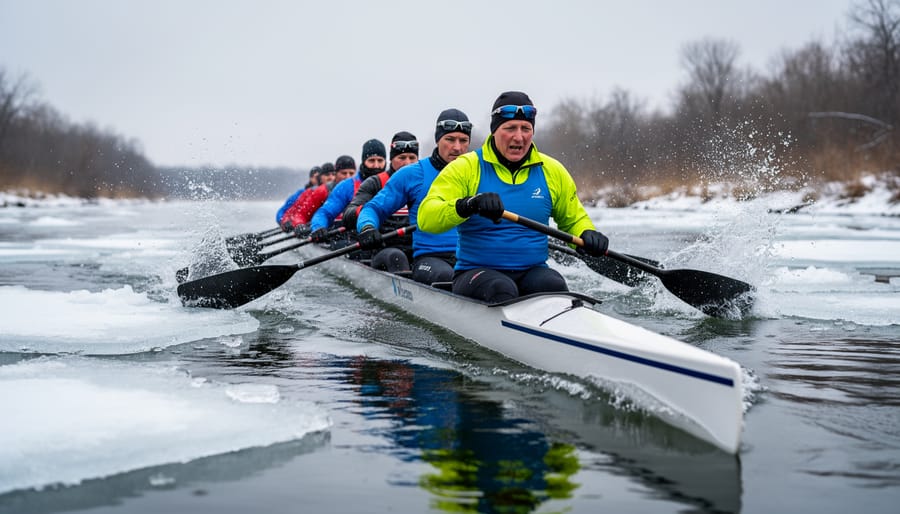
The Montreal Ice Canoe Challenge unfolds along one of the city’s most iconic stretches of water, turning the frozen St. Lawrence into a demanding racecourse that tests every ounce of a team’s grit. Starting at the historic Clock Tower in Old Port, teams launch their canoes knowing they’re about to face several kilometers of unpredictable ice and frigid water. The course loops around the west end of Alexandra Basin, cuts through toward Cité-du-Havre park, and pushes on to Parc Jean-Drapeau on Île Sainte-Hélène before circling back. It’s a setup that gives spectators incredible vantage points while throwing constant challenges at the racers.
Each team fields five members who work in brutal synchronization. When they hit open water, all five paddle hard. When they slam into an ice sheet, everyone leaps out and hauls the canoe across, then scrambles back in the instant they reach water again. There’s no pause, no second-guessing. The transitions between paddling and dragging happen in seconds, and a fumble can cost you the race. Teams rotate positions throughout to spread the physical load, but there’s no hiding from the cold or the exhaustion.
The race format typically involves multiple heats, with teams competing for the fastest times over the course. Weather plays a huge role here. Some years the basin is choked with thick ice floes that force teams into constant push-pull cycles. Other times, open water dominates and it becomes a straight endurance paddle through near-freezing temperatures. No two races feel the same, which keeps both competitors and spectators on edge.
What makes this location spectacular is the backdrop. You’ve got Old Montreal’s stone buildings rising behind the start line, the Jacques Cartier Bridge arching overhead as teams push toward the islands, and the city skyline framing the whole scene. For spectators bundled up along the waterfront, it’s visceral entertainment. You hear the scrape of canoes on ice, see the steam rising off athletes’ backs, watch teams gain or lose ground in real time. The course brings the action close enough that you feel part of it, which is rare for winter sporting events. It’s raw, it’s dramatic, and it captures exactly why ice canoe racing Quebec style has become such a draw.
Getting In on the Action: Registration and Participation
So you’re ready to trade spectator status for a paddle and a spot on the ice? Getting into the Montreal Ice Canoe Challenge takes some planning, but the payoff, experiencing Quebec’s most intense winter sport from the inside, is worth every frozen fingertip.
Registration for the 2026 event opens February 13, so mark your calendar if you’re serious about racing. Early-bird pricing gives committed teams a break on entry fees, and given the limited capacity, hesitation means watching from shore again. The event organizers cap participant numbers to maintain safety standards on the St. Lawrence course, so slots fill fast once registration goes live.
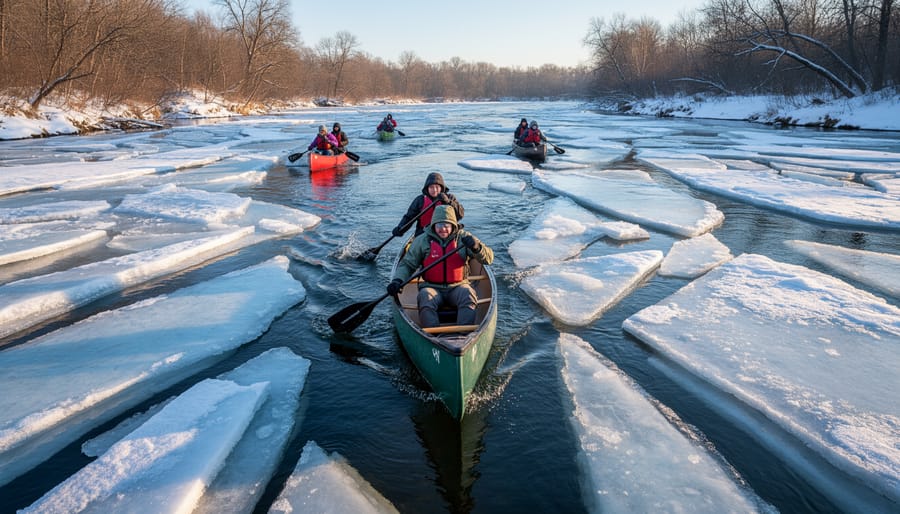
What prospective racers need to know: you’re entering as a team, not an individual, and ice canoe racing demands serious physical conditioning. Teams train for months in advance, building the specific strength needed to haul a loaded canoe across jagged ice floes and paddle through near-freezing water. It’s not a casual weekend warrior activity, you’ll need cold-water safety awareness, teamwork skills honed through practice runs, and gear that can handle the St. Lawrence’s winter conditions.
Since the event’s status changes annually based on ice conditions and safety assessments, check official channels closer to winter for confirmation that the race is running. Quebec’s ice canoe racing season depends heavily on river freeze patterns, so flexibility matters. Whether you’re forming a new crew or joining an established team, starting your prep work months ahead gives you the best shot at making the start line when race day arrives.
Why Ice Canoe Racing Fits Montreal’s Winter Social Scene
Ice canoe racing isn’t just a spectator sport in Montreal, it’s a full-blown winter celebration that taps into the city’s deep love for outdoor festivals and post-event socializing. The Clock Tower location puts racers and spectators right in Old Montreal, where cobblestone streets and centuries-old stone buildings create an atmosphere that’s uniquely Québécois. After watching teams battle ice floes on the St. Lawrence, the natural move is to warm up at one of the neighborhood’s countless bars and bistros where the racing crowd reconvenes.
The après-race scene is where the event truly comes alive. Teams still in their drysuits huddle around outdoor heaters at waterfront terraces, swapping stories about which ice chunk nearly capsized them or how they shaved seconds off their time. Spectators who spent an hour cheering from the basin join the mix, creating that easy camaraderie that defines Montreal’s winter social culture. Places near the Old Port fill up fast, think craft beer spots serving hefty poutines, cozy wine bars with fireplaces, and late-night haunts where the energy carries well past sunset.
This blend of extreme outdoor competition and warm indoor celebration mirrors what makes Montreal winters bearable and even beloved. The city has mastered turning brutal cold into social opportunity, and ice canoe racing slots perfectly into that tradition alongside Igloofest, Fête des Neiges, and the countless impromptu gatherings that pop up whenever fresh snow falls. The race gives people a reason to bundle up, head outside, and embrace the season instead of hiding from it.
For visitors exploring Montreal’s nightlife and entertainment scene, catching an ice canoe event offers something you won’t find anywhere else, raw athletic drama followed by the kind of spontaneous, communal warmth that defines how Montrealers actually experience winter. It’s competition, spectacle, and celebration rolled into one frozen package.
Spectator’s Guide: How to Experience the Race
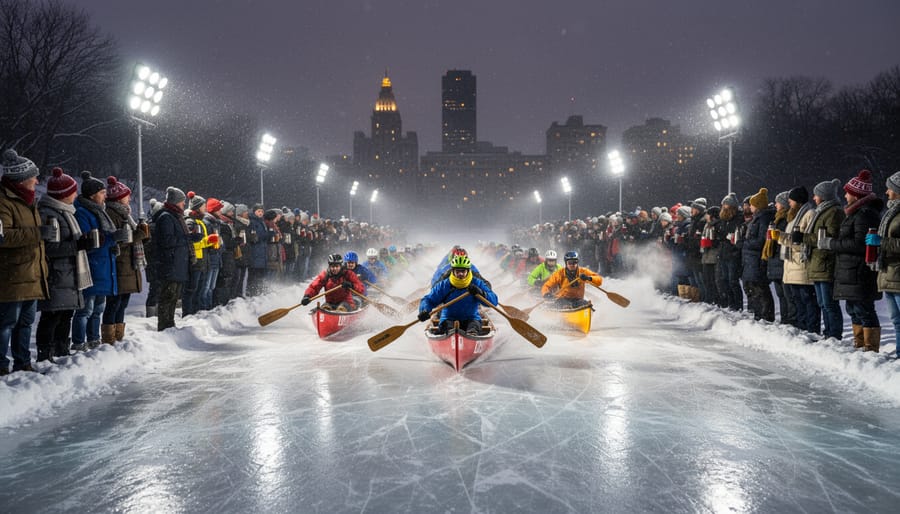
Getting ringside to the ice canoe action in Quebec doesn’t require much, but a few smart moves will seriously upgrade your experience. The raw spectacle plays out just steps from Montreal’s waterfront, and if you time it right, you can catch the chaos, get killer photos, and still warm up with a hot drink before the teams even finish.
Staking Out the Best Spots
The Clock Tower starting line delivers maximum energy, teams exploding off the dock, voices shouting, canoes scraping across ice. You’re close enough to feel the spray. For a wider perspective, walk over to Cité-du-Havre park where you’ll catch teams hauling canoes over ice floes mid-race. Parc Jean-Drapeau on Île Sainte-Hélène offers another vantage, especially if you want to see the return loop. Arrive 30 minutes early to claim a good sightline, because once word spreads, prime viewing real estate fills fast.
Gear Up Like You Mean It
This isn’t a stroll through Old Montreal. The wind off the St. Lawrence cuts hard, so layer up with a solid winter coat, insulated boots with grip (ice gets slick), and bring a scarf you can pull over your face. Thermal gloves are non-negotiable if you plan to take photos. Hand warmers stuffed in your pockets are clutch for extended viewing.
Here’s your game plan for making the most of race day:
- Check the event schedule early and plan to arrive 30-45 minutes before the first heat to secure a prime viewing spot near the Clock Tower or Cité-du-Havre park.
- Dress in full winter gear, layered coat, insulated waterproof boots, thermal gloves, and a face-covering scarf, since you’ll be stationary in frigid conditions near open water.
- Bring a camera or smartphone with a full battery (cold drains them fast) and scout angles from different points along the course for dynamic shots of teams battling ice and water.
- Map out nearby cafés, breweries, or food spots in the Old Port before you go, so you can duck inside to warm up between heats or celebrate after the race wraps.
Photography-wise, continuous shooting mode captures the gritty action, canoes smashing through ice, water flying, faces strained with effort. The contrast of bright gear against grey ice and dark water makes for striking shots.
After the race, the Old Port’s packed with spots to thaw out. Crew Bar and Terrasse Bonsecours pull a post-race crowd, while Marché Bonsecours and nearby bistros offer solid food and warmth. Make a day of it, soak in the atmosphere, and you’ll understand why this frozen madness has become a signature Quebec winter tradition.
Whether you’re braving the cold to watch teams battle ice and water or planning to join a crew yourself, ice canoe racing delivers an unforgettable slice of Quebec winter culture you won’t find anywhere else. The Montreal Ice Canoe Challenge captures everything that makes this city’s social scene special, adrenaline, community, and the kind of raw outdoor spectacle that brings strangers together over hot drinks and shared amazement. It’s not just a race; it’s a celebration of winter done the Montreal way, where extreme sport meets festival atmosphere along the St. Lawrence.
Mark your calendar for registration opening on February 13, 2026, grab your warmest gear, and head down to the waterfront when race day arrives. Scout your viewing spot near the Clock Tower or Parc Jean-Drapeau, camera ready. Then join the crowd at a nearby bar afterward to swap stories with racers still buzzing from their run. This is Montreal winter entertainment at its most authentic, equal parts thrilling, social, and uniquely Quebecois.